
Stories abound in cemeteries with military cemeteries no exception partly because of all the documentation available. Fort Rosecrans National Cemetery became one of seven national cemeteries established -1934-1939 – between the two World Wars. An aging population of veterans added to the need in light of available grave space in existing national cemeteries. Veterans’ benefits included burial space. On the Pacific Coast, at the time of establishment of the cemetery here, only one national cemetery existed in San Francisco. Army and Navy officials tried earlier to change the post cemetery at Fort Rosecrans as a national cemetery only to have the Department of War turn them down. The massive expansion of the military during World War I changed the situation dramatically.
Today’s post focuses on the pre-World War II sections of the Fort Rosecrans Cemetery – monuments to a battle from the Mexican American War; a battalion of Mormon volunteers from that war; a gunship boiler explosion and then a look at some of the aviators from the 1920-1930 era.
A later post will deal with World War II and beyond; Medal of Honor winners – there are 22 buried here – beyond those mentioned. And still another will focus on some of the flag officers (Officers with the rank of Lieutenant Commander through Admiral for the Navy and Major through General for the Army and Marines Corps) because there is more information generally available for those individuals.
FORT ROSECRANS – THE POST

San Diego originally centered near the San Diego River at the mouth where today Interstates 5 and 8 intersect. Late in the 1860’s and early 1870’s, commercial activity moved south to the New Town where the modern Downtown exists today. Both Mexican and later American military presence grew up on Presidio Hill to the immediate east of Old Town. With the development of New Town, however, the main focus of the army became the development of a supply depot – San Diego Barracks – from which other military posts throughout southern California and the Southwest could receive supplies from.

At the end of the war with Mexico, the south end of Point Loma became set aside by President Millard Fillmore with land reserved for a lighthouse at the south tip and one at Ballast Point. (presently occupied by a submarine base) – and other land for a quarantine station.
a new fort
There was a small fort built by the Spanish on Ballast Point and a post-Civil War battery but never materialized. Money was not set aside until late in the 19th century to bring the installation in line with other coastal artillery forts designated to defend the harbors of the US under the Endicott Program.
The fort, named for Major General William s. Rosecrans, a West Point graduate of 1842 who played major command roles for the Federal Army during the Civil War. Troops transferred over from the San Diego Barracks (That post soldiered on until 1921 when given to California which used that post as an armory for the California National Guard. Today, there is only a plaque on the side of the complex making up the Park Place condominium complex near the Convention Center.)

The fort mainly saw elements of the Coast Artillery stationed here, a role they played defending the harbor of San Diego until after World War II. Battleships and coast artillery both phased out with the rise of air power. Defense took on a much different outlook.
POST CEMETERY
Atop Point Loma, a cemetery became established in 1879 known as Fort Rosecrans Post Cemetery, San Diego Barracks (Point Loma). The first burial dates to 5 October 1879. With the establishment of Fort Rosecrans, the title of the cemetery changed to Fort Rosecrans Post Cemetery. The original cemetery occupied one acre – today it exceeds forty. Soldiers of the First Dragoons who died at the Battle of San Pasquale – 6 December 1846 – were reburied here (Originally, they lay buried on the battlefield just east of the San Diego Zoo Safari Park near Escondido.).
San Pasqual

The Battle of San Pasqual occurred 6 December 1846 as the 100 men under Brigadier General Stephen Kearney came into contact with a force of some 75 men led by Andrés Pico. Kearney lost 18 dead and 13 wounded – including himself – while the Californios lost 12 wounded and 1 captured. Reinforced with 200 men by Commodore Robert Stockton, the losses were remade and the Californios eventually beaten. The Americans who fell at San Pasquale lay buried on the battlefield. They were later transferred to a plot in Old Town San Diego before moving to a post cemetery at Point Loma and, eventually, to Fort Rosecrans.

There is a stone erected by the San Diego Parlors of Native Sons and Daughters of the Golden West in 1922 lists the American dead. Many of the dead could not be identified, only the officers – the two company commanders, brothers-in-law Thomas Hammond and Benjamin Moore lie identified nearby.
Like many of the older national cemeteries, private headstones appear popping up here and there in the older sections. Families are responsible for the upkeep of such memorials in perpetuity. Most national cemeteries do not allow private headstones anymore, citing problems with space and extra upkeep of the grounds around such memorials. Private headstones were allowed in cemeteries like Arlington and here at Fort Rosecrans until 1947.
Mormon Battalion

A white marble tablet dating to the late 1990s remembers the 2,000 mile journey undertaken by Mormons who took part in the 1846-1847 march by members of the Mormon Battalion. The founder of the Mormon faith, Joseph Smith, along with his brother, Hyrum, were murdered 27 June 1844 amid persecutions suffered at the hands of non-Mormons they had settled amongst in Illinois. Following their deaths, persecutions continued. After Brigham Young assumed leadership of the majority of the Mormon community in and around Nauvoo, Illinois, it was decided to seek new lands where they could live and worship in peace.

Seeking federal assistance, President James Polk agreed to request a battalion of 500 volunteers to help in the war declared against Mexico from the Mormon refugees gathered along the Missouri River in preparation for their own move west. Polk wrote the men would join “as volunteers … with a view to conciliate them, attach them to our country, and prevent them from taking part against us.”
Young agreed seeing a public relations win for the movement, showing evidence of their loyalty to the United States. In addition, a uniform allowance of $42 per volunteer was paid in advance. With a one-year enlistment, the men were allowed to continue to wear civilian clothes. The funds then went mostly to the church’s general fund to help with the main group’s expenses in their upcoming exodus.
marching as to war

Mustered into service 16 July 1846, the Mormon Battalion under the command of Lieutenant Colonel James Allen. They were to become part of Brigadier General Stephen Kearney’s Army of the West which included two regiments of Missouri volunteers and a regiment of New Yorkers who traveled to California by way of ship around Cape Horn. Kearney had already marched west with about 1,700 men on the Sant Fe Trail at the end of June. His goal was to conquer both New Mexico and then California.
Some 33 women and 51 children accompanied the Battalion as they marched out. Each company of men was allowed four women as laundresses who also received rations – 20 of the women served in those roles. Five of the women would eventually reach California.
Arriving in Santa Fe in October, 91 of the men and off the women except for five and 50 of the children were sent of to Pueblo, Colorado to spend the winter – the men who left were sick, sent to recover. The rest of the Battalion, under the command of Captain Philip St. George Cooke traveled some 1,110 miles over the next three months – one of their party added on was Jean Baptiste Charbonneau who as an infant had been part of the Lewis and Clark Expedition.
San Diego and beyond

The Battalion reached San Diego 29 January 1847 – 2,080 miles from their starting point in Iowa. They served for five more months as occupation forces in southern California, giving Kearney extra needed reinforcements. Twenty-two of the men died during their service – none through battle and another 80 re-enlisted for an additional six months. About 100 men were working in the Sacramento area when gold was discovered late in January 1848. Before moving on to the new Mormon home in Utah, they brought another $17,000 in gold.
There are several Mormon Battalion monuments scattered about the routes taken by the Battalion. One of those is here at the cemetery with the image of a man and a woman engraved – Albert Dunham and Lydia Hunter presumably. They both died during the march and their bodies were eventually laid to rest at the Post Cemetery in 1887. Lydia was the second wife – plural wife – of Captain Jessie Hunter, in command of Company B. He left his first wife, Keziah and five children behind in Iowa in the “care of the bishops” though he later took his eldest son with him to serve as a “musician”. Lydia died shortly after childbirth in San Diego of probable typhoid fever. Dunham, an 18-year-old private, died a few days after Lydia, maybe from the same epidemic.
SPANISH AMERICAN WAR
Colonel Edward Pennington Pearson

Edward Pearson’s headstone mentions his final Regular Army rank of Colonel. Pearson took part in the Civil War enlisting with the 25th Pennsylvania Infantry Regiment popularly known as the “First Defenders” for their early arrival in Washington, DC to defend the newly inaugurated President Abraham Lincoln.
The 25th Pennsylvania was one of the early Federal regiments organized optimistically for only three months of service. Being a civil engineer from Reading, Pennsylvania, Pearson enlisted with the local Ringgold Artillery – Company A of the 25th. The company billeted inside the US Capitol Building with President Lincoln shaking the hands of every volunteer. For the duration of their enlistment, they served guarding the arsenal in the District. Most of the men would re-enlist at the end of the three months with the 96th Pennsylvania, but Pearson signed on as a First Lieutenant with the US 17th Infantry Regiment One of several newly raised regiments of the Regular US Army.
peaarson’s long list of duty
The 17th served as part of George Sykes Regular Division of the Fifth Corps of the Army of the Potomac. He participated in the battles of the Peninsula Campaign, Second Bull Run, Antietam (now as a company commander), Fredericksburg and Chancellorsville. After Fredericksburg, he was tabbed for service on the staff of Major General Otis O. Howard, commander of the XI Corps. That corps shifted to the Western theater after Gettysburg where he spent the rest of the war with Howard. Pearson followed Howard when Howard became the commander of the Army of the Tennessee. He followed that army through Sherman’s March to the Sea and the last battle in the Carolinas at Bentonville, gaining brevet promotions to Major and Lieutenant Colonel.
After the war, he returned to the US 17th as a captain serving in Texas and the Dakota and Montana Territories making the rank of Major of the 21st US Infantry in May 1881. With the 21st, he served in Idaho, Oregon, Nebraska and Wyoming. Jumping to the 24th US (A Buffalo Soldier regiment made up of African American soldiers), he made the rank of Lieutenant Colonel in April 1886 and finally became the Colonel of the 10th US in October 1891, still serving in the West.
With the Spanish American War, he led the 2nd Brigade of the Fifth Corps (Which included both his 21st and 10th US regiments) at San Juan Hill 1 July 1898 gaining the rank of Brigadier General Volunteers. He retired shortly after the war suffering from malaria he picked up in Cuba.
Grave site – section PS-4, grave 107
USS BENNINGTON

A tall granite pillar erected by the Pacific Squadron pays homage to the thirty-six of sixty victims buried here following a boiler explosion on 21 July 1905 on the USS Bennington. The Bennington began life as the last of three Yorktown-class gunboats dating back to 1891. After seeing service in the Caribbean, Atlantic and Mediterranean, she transferred to the Pacific via Cape Horn. During the Spanish American War, she spent time guarding Hawaii and California before a September deployment to Asia taking possession of Wake Island along the way.

Returning to the West Coast, she spent 1902 undergoing an overhaul in a shipyard before heading out to sea as part of the Pacific Squadron. After sailing from Alaska to South America, she returned to San Diego in late July 1905.
fate of the bennington
A few days before she was to put to sea, the boiler blew up. The explosion left the 1700-ton ship partly beached and partly sunk. The ship was refloated and towed to San Francisco where at the Mare Island Navy Yard it was decided to not repair the now somewhat old gunboat. Sold at the end of 1910, she was converted into a barge and taken to Hawaii where she continued service as a molasses barge for the Matson Shipping Company until early 1924 when she was scuttled off Oahu. A description of the boiler explosion from the New York Times can be read here.
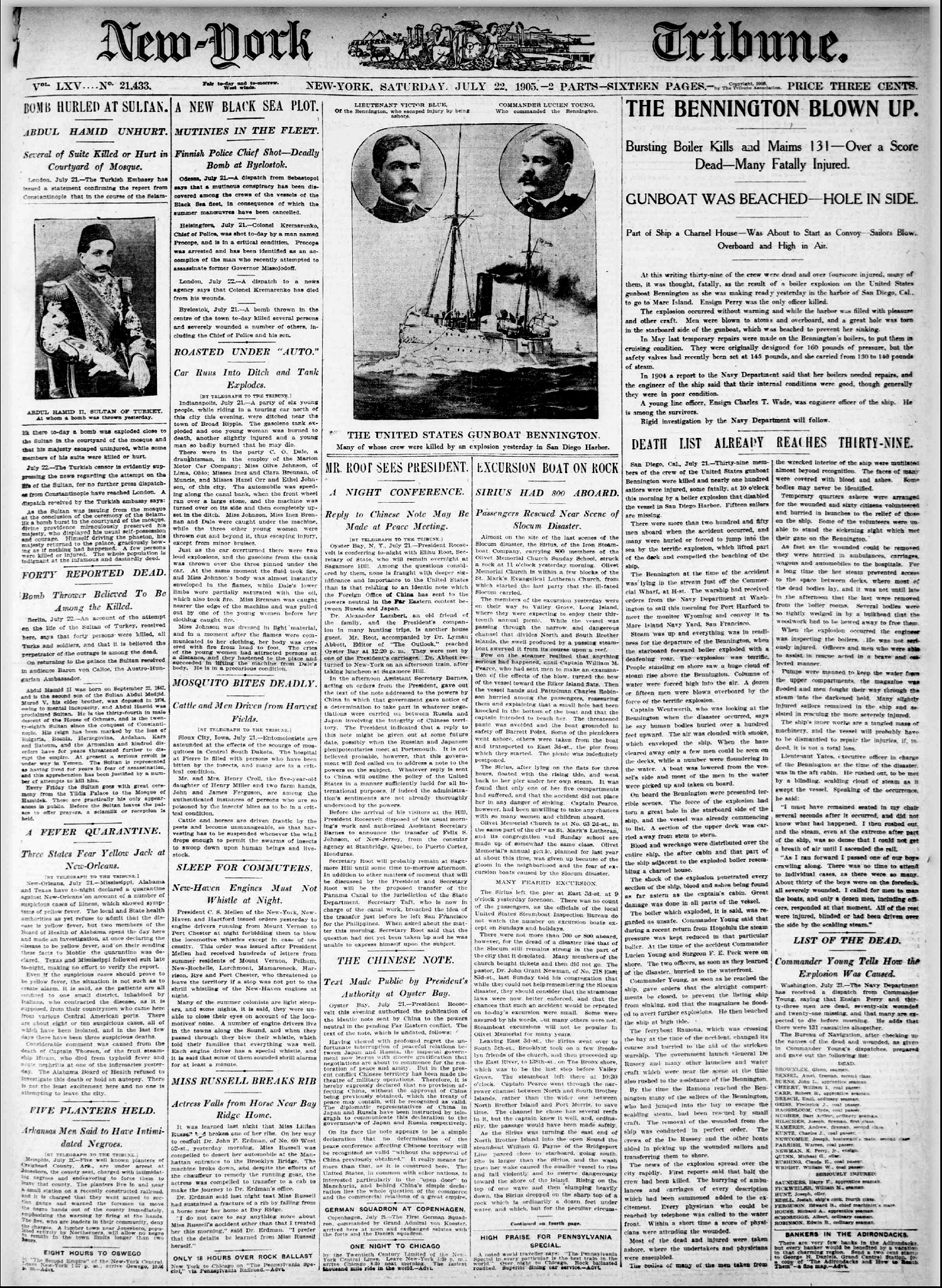


The 60-foot-tall monument resembles the much taller Vermont monument commemorating the revolutionary battle for which the gunship gained its name. It saw dedication on the site of the graves of those men who still remained at the Fort Rosecrans Post Cemetery 7 January 1908 – several of the dead had been disinterred and sent home to families by that date. A low granite wall borders the graves of the sailors who died.
William S. Cronan

The Bennington carried a crew of 197 officers and men though there were only 112 on board on the morning of the accident. Of those, 66 died outright from the explosion. Just about everyone else aboard suffered injuries of some sort. Eleven men earned a Medal of Honor for “extraordinary heroism displayed at the time of the explosion”. One was 22-year-old Boatswain’s Mate William Cronan.
Although injured, Cronan saved three men from drowning on the day. A plaque on a bench in the city of Coronado remembers his actions, “Despite being hurled into the water and seriously burned, Cronan climbed back on board the sinking ship to help rescue injured and dying mates.”
He went on to serve for almost 45 years in the Navy retiring with the rank of Lieutenant Commander at the end of 1946. Retiring in Coronado, he lived until 1959. Promoted to the warrant officer ranks of gunner in 1909 and chief gunner in 1915, he finally gained permanent officer status in World War II.

Grave site – section T, grave 534
A NEW NATIONAL CEMETERY

With the tragedy, Army and Navy leaders pushed in light of now crowding in the small one-acre cemetery, for more funds to transform the little cemetery into a larger national cemetery. Money, always tight before World War I (And again between the World Wars), did not become available since the War Department decided there was more than enough space at the San Francisco National Cemetery to provide burial space for veterans on the West Coast.

post world war i developments
That all changed in 1921 with the establishment of the Veterans Bureau. World War I dramatically expanded the number of veterans who were eligible for burial within the national cemetery system. Both the Bureau and the system underwent further development with the creation of the Veterans Administration in 1930 and the National Cemetery Administration in 1973. With thousands of eligible veterans living now on the West Coast, Fort Rosecrans Post Cemetery became the Fort Rosecrans National Cemetery on 5 October 1934. In the succeeding years, the cemetery – grown into 8 acres by 1934 – grew to over 62 acres by 1965. Much of the work of construction was completed through the efforts of the New Deal Works Progress Administration. The cemetery filled fairly quickly and by 1940 space became limited.
Additions took place with cemetery buildings, and a final acre was added to the cemetery from the Department of the Navy (The Navy took over the grounds of Point Loma after the post-World War II closure of Fort Rosecrans.). Only a year later, the cemetery closed to most burials. Walls for columbaria cremains and in-ground niches developed in 2002 and filled up by May 2014 when the cemetery closed for new burials. To give additional burial space, the Miramar National Cemetery opened 16 miles north of Fort Rosecrans in 2010.
EARLY AVIATORS
Always a First


San Diego was not the Navy Town we see today in the early part of the 1900s. After World War I and the gradual worsening of relations with Japan, the port evolved into the home of the Third Fleet, home to three aircraft carriers which share space with 55 other warships and four submarines. In 2024, the Navy and Marine Corps combination pumped $63 billion into the economy of San Diego County with 110,000 active-duty personnel, 6,000 reservists and 30,000 civilians.

In 1911, under the tutelage of aviation pioneer Glenn Curtiss, Theodore Ellyson became the first Navy officer to qualify as a pilot. Ellyson foresaw the airplanes’ future in 1912 as “In my opinion, the aeroplane will be used by the Navy solely for scouting purposes, and not as an offensive weapon as seems to be the popular impression.” While Ellyson was not a prophet when it came to naval aviation, he did continue to work in aviation. During World War I, he developed tactics for an American submarine chaser squadron working out of Plymouth, England for which he received the Navy Cross.
Continuing work in aviation after the war, he helped fit the USS Lexington for duty as the Navy’s second aircraft carrier in 1926. Two years later, he died after a night crash into Chesapeake Bay. He lies buried at the Naval Academy Cemetery in Annapolis from where he graduated in 1905.
Air Station North Island

In 1917, the Navy established the first permanent naval air station at Naval Air Station North Island across from Fort Rosecrans on Coronado. But it was the Army who first came to North Island in 1912 as the Signal Corps Aviation School relocated at the end of 1912 to San Diego from College Park, Maryland to enable year-round flying conditions.
Both Curtiss and the Wright Brothers moved training here establishing hangars and using rented airplanes. With World War I and the need to train pilots, North Island became federally owned with the army taking the south end of the island and the navy taking the north end. Both the 6th Aero and 7th Aero Squadrons initially trained at the Rockwell Field – the name given to the Army’s airfield. Eventually, after a visit to North Island in October 1935, President Franklin Roosevelt – an old Navy hand – transferred Rockwell Field over to the Navy with the Army moving out to March Field near Riverside, California. By this time, the Navy had shifted from using seaplanes to land planes working off of aircraft carriers. The USS Langley, the Navy’s first carrier called San Diego home in 1924 and by 1935, San Diego based all four of the Navy’s carriers.
INDIVIDUAL AVIATORS

There are many aviators buried here at Fort Rosecrans. Men from the Navy, Marine Corps and the Army (Air Corps) all lie here. When visiting a cemetery, I might know a little bit about those buried here beforehand. I try to take pictures of headstones which may have underlying fascinating histories. It is only after a visit, with further study, that I find out I did not take enough pictures. So, while not a complete picture of early aviators buried here, I will present an interesting capture of some of the men who did serve here early in the history of North Island.
With North Island and Rockwell Field as training centers, accidents are expected to happen, I guess. Accidents occurred frequently in the early era of heavier-than-air life. Graves here at Fort Rosecrans reflect those sad events. With just a short visit to the cemetery, many other aviators doubtlessly lie at rest here. Three came into view of my camera from the latter 1920s.
Aviation Pilots
Aviation Pilots were a special new rating used for enlisted men who trained and qualified as pilots. The rating already saw use in both the Army Air Corps (The Air Corps Act of 1926 mandate at least 20% of pilots consisted of enlisted men for purposes of pay economy in the cash-strapped post-World War I world of the Army) and the Marines (There first enlisted pilots were in 1919. That program ended in 1972 though there is some thought in both the Marines and Navy to re-institute it because of shortages). The Navy actually began training enlisted pilots between 1916-1918 (The Army began using enlisted pilots as early as 1912). The Navy graduated seven petty officers and two Marine Corps sergeants (Again, the official Marine program started a few years later) as aviators in 1916.
The problem with the enlisted-to-pilot program was “attrition rates during training period for enlisted men were considerably higher than among officers. . . crackups were considerably higher and it was concluded that training enlisted Pilots was even more expensive than training officer Pilots.” For the Navy – and Marine Corps – the biggest use of enlisted pilots occurred in World War II. Postwar reduction in forces eventually ended the programs for both the Navy and the Marines, though enlisted men still fly as pilots in the Army (As Warrant officers).
Jeff Bush Davis

Jeff Bush Davis was a Marine First Sergeant, a member of the Marine Second Aviation Group. He qualified as an Aviation Pilot in 1924. Enlisted Naval Aviation Pilots (NAP) D-G Only after flying for two years, he was involved in a ground crash collision while flying a Vought VE-7 (A-5930). He might gain inclusion among those enlisted numbers involved in higher numbers of “crackups” versus officer Pilots.
Grave site – section PS-2, grave 182
Frank Joseph Brady

On 12 March 1924, the Bureau of Navigation (The Naval command responsible for managing and training personnel) established the rating of Naval Aviation Pilot (NAP) for Chief Petty Officers. At the same time, the Navy enlisted rating of Chief Aviation Pilot (CAP) established in 1924 (An act repealed in 1949) for those qualified in heavier-than-air craft. As the program continued, the Navy expanded the NAP rating for first class petty officers in September of 1927.
In the U.S. Navy, the title “Chief Aviation Pilot” referred to senior enlisted aviation pilot who has completed advanced flight training with the rank of Chief Warrant Officer (CWO. These men represented some of the most experienced enlisted aviators in the Navy, often serving as instructors, test pilots, or in specialized aviation support roles.
One of those experienced enlisted aviators was Frank Joseph Brady. He died at the age of 35 though The USN Accident Rports – 1928 does not show any incidents involving him, so possibly he did not die in the line of action.
Grave site – PS-2, grave 186
The Vought O2U-2 “Eyes of the Navy”


The O2U-1 was purchased by the Navy, 130 planes in 1927. This first version of the Corsair developed into three other versions successively improving upon the original seeing service not only in the US Navy, but many other national air services, as well. A 450 horsepower Pratt & Whitney Wasp engine gave the original models a top speed of 151 mph (243 km/h). A metal framework with the fuselage skinned from the engine back to behind the pilot’s seat in metal alloy with the wings and rear fuselage covered with fabric. The Marines used the O2U-1 as a ground support plane in Nicaragua as early as 1928. First Lieutenant Frederick Schilt earned a Medal of Honor flying ten times into a besieged town delivering needed equipment and taking out wounded Marines in a landing zone only 100 feet in width – the plane spanned 32 feet.

The Second Corsair was the O2U-2 developed from the first version of the biplane model with larger wings and tail section providing better maneuverability. Many were built with floats to be used at sea aboard ships to serve as “the eyes of the Navy”. Versions of the plane continued being built until 1937 and served as the Navy’s standard observation plane until 1939. They would serve during World War II with the Navy at the beginning of the war and as trainers and with the Coast Guard until 1945.
Herbert Herman Brown

Herbert Herman Brown was one of the earliest Naval Aviators receiving his gold wings in 1917 during World War One. He was flying backseat as a radioman in a two-seat O2U-2 Vought Corsair fighter-scout on 19 April 1929. Their plane was part of Scouting Squadron 3 assigned to the aircraft carrier USS Lexington at the time but were operating at the time out of North Island. Flying with Lieutenant William K. Patterson as his pilot, they returned from aerial gunnery practice near Oceanside and prepared land at the air station. Ensign Herbert Bassett, Jr. carrying another ensign, Harold B. Sheehan, a graduate of the Naval Academy class of 1923, locked wings with Patterson’s plane. The wrecks fell 400 feet down into shallow waters covering a mud flat off the golf course at Coronado.
All three officers died instantly. Brown was thrown from the wreck. The local fire department picked him up, but he died on the way to the naval hospital. He served in the Navy for almost eleven years leaving a wife behind. Patterson and Bassett are buried at Arlington while Sheehan lies with his family in Natick, Massachusetts.
Grave site – section PS-1, grave 468
Earle Lewis Searl Jr.

Remember, it was not just the Navy flying off North Island. Edward Lewis Searl Jr. was an Army pilot. At some time, he or his wife Shirley had seen the Fort Rosecrans Cemetery and thought it was a good place to lie at the end of one’s time. According to the New York Times, “Lieutenant E. L. Searl Jr., Brooks Field instructor, who recently came here from Manila, P. I., was killed, and Flying Cadet Roy A. Strickland suffered a broken arm, cuts about the face and body injuries, when their plane plunged down today. The men were in a Brooks Field instruction ship. Witnesses said the machine went into a nosedive at an altitude of about 500 feet.”
Brooks Field is at Fort Sam Houston in San Antonio, Texas. Both Edward and his wife Shirley lie underneath a large headstone here at Fort Rosecrans.
Grave site – section PS-3, grave 321

Note – his son, Edward L. Searl III also lies at Fort Rosecrans. Following in his father’s footsteps as a young 20-year-old Second Lieutenant with the 25th Army Fighter Squadron, he died 5 June 1943 of “non-battle death”. The squadron was in India at the time operating against the Japanese in Burma. His grave site – section G, grave 21
Another Army pilot aside

Another quick mention of Army pilots should be noted. On the same day in which Herman Brown died, an Army pilot, Lieutenant Howard Keefer, collided with a Ford Trimotor Maddux airliner 1800 feet above San Diego. Keffer, the two Maddux pilots and three passengers all died in the incident. It seems military pilots of the time enjoyed bringing some realism into their practice flights. They would “stunt” around the airliners giving the passengers “thrills” while thoroughly upsetting the airline pilots.
The problem was Keefer was flying a Boeing PW‑9D pursuit fighter (28‑037) very maneuverable based upon the German Fokker D.VII one of the best German designs of World War I. The Ford Trimotor – also based upon a German design, the Fokker F.VII trimotor – carried passengers slowly in a straight line. It was not meant to fight dog fights in the sky. Keefer, reportedly playing “a hairbreadth game with death,” attempted to pass in front of the slower airliner. Witnesses said the two planes appeared to lock wings for a moment before the fighter struck the Tri‑Motor’s cockpit. The collision caused the fighter to enter an uncontrolled dive and the Tri‑Motor to break apart mid‑air.
STUNTS AND AIRLINERS DON’T MIX WELL


One golfer on the ground recounted, “the planes were so close that he thought they were flying in formation until realizing that the Army craft was performing aerobatics around the airliner.”

The owner of the airline, J. J. Maddux, issued a definitive statement, “There is no doubt in my mind that the crash was entirely the fault of the pilot stunting above our plane as it took off from San Diego. Ever since we have been flying [from San Diego], government pilots have been bothering us and frightening our passengers, and we have received many complaints about their actions.
“I have taken the matter up with the government many times, but because of red tape and other reasons we have never been able to remedy the situation…it is virtually impossible [for our pilots] to obtain the number of the plane [while in the air] and that is one thing the government always demands.”
Howard Keefer lies buried in his hometown in Michigan. His hometown paper noted Keefer had previously mentioned, “If I go, I want it to be with wings.” He got his wish. The trouble was he took five others with him.
LATER AVIATORS
With as short of time as I had to spend at the cemetery there was no dearth of men and their stories I missed out upon. Many of the men who flew in World War II, Korea and Vietnam and survived, lay here, but in the newer sections. After 1947, headstones are not as individual as those who died before. That said, a couple crept into pictures I took, as well as a couple which I searched out amongst the anonymity of today’s national cemeteries.


One mystery I noted was First Sergeant Jack A. Kerr who was a member of the 32nd Bomb Squadron. His death was 2 February 1933. At the time, the squadron, recently reactivated at Rockwell Field 24 June 1932 comprised of men drawn from transfers and enlistment. The squadron at the time was one of two which used amphibian airplanes as their standard. They trained in experimental nature including navigation and sea observation.
No notes of accidents are noted on the USAFF accident Report web post for 1933 so maybe his death was not in the line of duty.
Grave site – section PS-1, grave 519
Donald L. Webber

Looking now at one aviator from the World War II era because of his death resulting from a training accident similar to those other men from the 1920-1930 era. Donald L. Webber was a captain flying a P38 L Lightning on a training mission north of Baker, California. On 12 February 1945, he collided with another Lightning flown by Captain William D. Horton. They were part of a five-ship flight flying out of Daggett Municipal Airport on a scheduled camera gunnery mission. Capt. Horton was flying in the number three position; Capt. Webber was in the number two position. The flight rendezvoused with the target ship, and the aircraft began making their camera gunnery passes.
The two subject airplanes entered into a pass at the target ship simultaneously, with Capt. Webber in front and slightly below. The airplanes peeled off the target and collided. Both airplanes went out of control and impacted the desert floor destroying the aircraft and killing both pilots.
Grave site – section OS, grave 277
OTHER MONUMENTS
Other monuments in the cemetery are found across the street from the older section just inside the main gate facing where the entry road circles to the north and south around the section A1 in front of the Administration Building. The other major group of monuments is by the other A1 section next to the Committal Shelter further south found where section O, P and Q intersect.
The majority of the monuments commemorate ships lost in battle and most of those at the Battle of Leyte Gulf 23-26 August 1944. That battle occurred in dispersed areas in and around the island of Leyte in the Philippines. The ships commemorated here fought in the seas off the eastern shores of Samar. Leyte Gulf represented the largest naval battle in history. A last throw of the dice by the Imperial Japanese Navy, it did not go well for them thanks in a large part to the sacrifices made by the men and ships remembered here on granite – bronzed blocks.
Here, the US Navy writes its version of the battle. The National World War II Museum in New Orleans offers its story here.
SECTION A1 BY THE ADMINISTRATION BUILDING
USS St. Lo

One such CVE was the St. Lo. Two monuments to CVEs flank the monument to the USS Wasp, a Fleet carrier. Like its sibling, the USS Ommaney Bay, the St. Lo came out of the Ryan Point yard in Vancouver, Washington. It only took nine months (23 January until 23 October 1943) to build CVE 63 which originally gained the name USS Midway (Named for the 1942 battle which turned the tide of war against Imperial Japan) one of 50 CVEs of the Casablanca class. The greatest deficiency of the Casablancas was a lack of armor due to lack of space for it on the small carriers. Originally named Chapin Bay (A bay on the south coast of Admiralty Island in the Panhandle of Alaska), the name changed to Midway two months into construction.

As the Midway, she spent time from her commissioning until mid-1944 ferrying aircraft to both Pearl Harbor and Australia. From June to September, she joined the amphibious support fleet seeing action at Saipan, Tinian, Morotai and the Palaus before getting a new name, the St. Lo, on 10 October. The purpose of the name change freed up the name for a new class of large fleet carriers being built.
The St. Lo at Leyte Gulf

In mid-October, she joined Admiral Clifton Sprague’s Task Unit 77.4.3, better known as Taffy 3. From 18 to 24 October, she launched air attacks on several targets in the central Visayan islands of the Philippines in preparation for Douglas MacArthur’s return via Leyte. A pilot from the St. Lo was the first to discover Vice Admiral Takeo Kurita’s Center Force – 4 battleships, 8 cruisers and 12 destroyers – only 20 miles away from the Taffy 3 group bearing down quickly. Only ten minutes later, shells from the Japanese fleet started splashing around the vessels of Taffy 3.

The battle went on for three hours before the Japanese fleet decided to retire. Despite being straddled several times, the St. Lo survived without a hit. Only 41 minutes after securing from general quarters, the ship signaled an air attack. A Japanese A6M5 Model 52 “Zeke” with a bomb under each wing hit the rear flight deck at 1053 in the first kamikaze attack. After three significant explosions, the order to abandon ship was given and the ship sank at 1125. More than 140 of the 889-crew died. Their names are remembered on the bronze plaque, both of the crew members and those of her air squadron crews who died.

The vessel was found 75 years later at the bottom of the Philippine Sea by a team financed by the late billionaire Paul Allen. It was one of several vessels found in extreme deep depths, quiet monuments resting in the deepest and darkest parts of the seas.
USS Wasp

American aircraft carrier development and production between the Wars saw large limitations due to the Washington Treaty of 1922. This treaty limited the major powers to how many tons of ships each could produce per year. For aircraft carriers, this led to the transformation of two would-be battlecruisers into carriers – the Lexington and Saratoga. With only 69,000 tons left by the treaty to build carriers, what followed were the smaller sized Ranger CV-4 – 17,577 tons – deemed adequate for the Atlantic theater and the larger Yorktown and Enterprise – 25,000 ton – aircraft carriers. That left tonnage for a seventh carrier – 14,700 tons – which became the Wasp, using a reduced size Yorktown-class carrier hull. Like the Ranger, the Wasp planned to work only in the Atlantic against the perceived weaker German fleet.

Commissioned in 1940, that theater is where she worked until June 1942. Transferred to the Pacific to make up for American losses in the Coral Sea – Lexington – and Midway – Yorktown, the Wasp Wasp – CV-7 – supported the invasion of Guadalcanal arriving in early August 1942.
fate of the wasp
She continued in the region until 15 September when the Japanese submarine I-19 launched a spread of six torpedoes. Three hit the Wasp another hit the destroyer O’Brien and another damaged the battleship North Carolina (The most successful torpedo salvo in history).

The torpedo hits knocked out power on the Wasp, leaving damage control parties unable to contain fires. The ship was abandoned and the American destroyer Landsdowne eventually sunk the burning hulk. From the crew of the Wasp, 193 men died with 366 wounded. Forty-five of her aircraft sunk with the ship, while 25 of her 26 airplanes flying at the time landed safely on the nearby carrier Hornet. The I-19 went on to sink two Liberty ships, damaging another and crippling a fourth in 1943 before being caught by the destroyer Radford west of Makin Island 25 November 1943. She went down with all aboard.
The monument here at Fort Rosecrans National Cemetery lists the names of sailors, air crew and their maintenance people who died. The wreck of the Wasp was discovered in early 2019 by the Paul Allen-funded explorations by the RV Petrel which was successful in finding many wrecks of ships from the war in the Pacific. The Wasp was found lying upright at a depth of 14,255 feet – 4,345 meters.
USS Ommaney Bay

While it took Kaiser Shipyards at Ryan Point in Vancouver, Washington nine months to complete, the shipyards had learned how to use subassemblies for even quicker results by the time to build CVE 79. Laid down 6 October 1943, the ship gained its commission on 11 February 1944 after slightly more than four months instead of the nine it took to complete CV 63!
jeep carrier at sea
Named for a small bay at the southern extreme of Baranof Island (Sitka lies on the north end of this island) in the Alaskan Panhandle, the Ommaney Bay completed a traffic run of planes and supplies to Australia at the end of March 1944. After returning to San Diego at the end of April, she set sail for Pearl Harbor on 10 June for two months of training airmen. From 11 September for the rest of the month, the Ommaney Bay took part in the invasion of the Palau Islands helping to provide air cover for the fleet and ground support for troops ashore.
After a resupply run to Manus Island in the northern Admiralty Islands, she sailed to join Taffy 2 to help support the invasion of Leyte. At the Battle off Samar on 25 October, planes off the Ommaney Bay – six sorties launched that dayin support of their beleaguered and outmatched comrades in Taffy 3 – helped sink one Japanese cruiser and damage several other ships. She retired again to Manus to resupply. They followed up by congregating at Kossol Passage in the northern Palau group before returning to the Philippines for operations off the island of Mindoro. Retiring to Kossol Passage one more time, she prepared for the landings in Lingayen Gulf where the main invasion of Luzon was to take place in early 1945.
fate of the ommaney bay

Transmitting the Surigao Strait on 3 January 1945, she made it into the Sulu Sea where a twin-engined Japanese kamikaze successfully attacked the carrier. Nicking the carrier’s island, the plane crashed into the starboard side of the ship releasing bombs on the way in. Exploding ammunition and huge blazes among fully gassed planes forced the order to abandon ship at 1750 especially with the threat of stored torpedo warheads waiting to blow up. The ship officially sank after a torpedo hit from the destroyer Burns – DD 588. From her crew, 95 men from her crew and aviation squadron died. Another two men died on a destroyer nearby trying to assist. They died when the torpedo warheads finally did go off.
The wreck of the Ommaney Bay was identified 10 July 2023 by the Naval History and Heritage Command’s Underwater Archaeology branch.
SECTION A1 NEAR THE COMMITTAL SHELTER
Taffy 3 group

On the west side of the road leading to the committal shelter – this is where brief ceremonies are held for burials, though business must be slow since the cemetery closed for new burials long ago – you can find a series of monuments dedicated to the men of Taffy 3 – officially known as Task Group 77.4.3 commanded by Rear Admiral Clifton A. F. Sprague – he lies buried here at Fort Rosecrans – section P grave 1622. Supporting the American invasion forces on Leyte in the Philippines, the group was one of three groups of escort carriers – small carriers built quickly and could provide some planes – standing offshore for the main invasion transport fleet. Taffy 3 lay furthest to the north.

Taffy 3 comprised of four escort carriers – Fanshaw Bay (CVE-70), St. Lo (CVE-69), White Plains (CVE-66) and the Kalinin Bay (CVE-68) – of Carrier Division 25 under the command of Rear Admiral Clifton Albert Frederick Sprague and two carriers of Carrier Division 26 under Rear Admiral R. A. Ofstie with Kitkun Bay (CVE-71) and Gambier Bay (CVE-73). Helping to screen the carriers were three destroyers – Hoel (DD-533), Heermann (DD-532), and Johnston (DD-557) plus four Destroyer escorts – Dennis (DE-339), Raymond (DE-341) and Samuel B. Roberts (DE-413). They faced four battleships – including the sister ship of the Musashi, the Yamato – six heavy cruisers. Two light destroyers and eleven destroyers.
Taffy 3 Escort Carriers
Taffy Group 3 did have the support of the planes of two other escort carrier groups – Taffy 1 and Taffy 2 (Taffy 2 included the Ommaney Bay). That added a total of 450 planes to the equation

The escort carriers, manned with single 5-inch guns defended themselves as well as they could as they beat their way to the east under smoke laid down by their screen vessels. Some hits were made by the “pea shooters” of Taffy 3 but the constant air attacks confirmed to Japanese commander Admiral Kurita, he faced Halsey’s carriers instead of the little jeep carriers.

Gambier Bay was sunk by hits from the Yamato but three of Kurita’s battleships suffered moderate damage from the air. One further Taffy 3 carrier – St. Lo – sank after a hit from a kamikaze with damage done to three other carriers from the other Taffy groups – Kalinin Bay, Kitkun Bay and White Plains – in the same attack.
The Destroyer Screens

One granite monument mentions the ships of Taffy 3 and their losses in both ship and air crew. A second large monument lists the men of the three screening vessels, two destroyers – the Johnston (DD-557 and the Hoel (DD-533), l – plus one destroyer escort – Samuel B. Roberts (DE-413) which were sunk by Japanese gunfire. There were several others, but these paid the ultimate sacrifice blasted out of the water by forces considerably superior.
sacrifices off Samar

The Battle off Samar turned out to be one of those pivotal moments of World War II. Japan would have still lost the war, but they would have probably bought more time stopping or significantly hurting American invasion efforts on Leyte.
Besides the monuments here at Fort Rosecrans, there is a large monument erected to the memory of Taffy 3 next to the retired aircraft carrier USS Midway in downtown San Diego on the waterfront – somewhat appropriate since the original name for the USS St. Lo was the Midway.
DESTROYERS OF TAFFY 3

Three destroyers – Hoel (DD-533), Heerman (DD-532), and Johnston (DD-557) plus four Destroyer escorts – Dennis (DE-339), Raymond (DE-341) and Samuel B. Roberts (DE-413) – were designated to provide screen protection for the escort carriers of Taffy 3. As the Japanese center force emerged from San Bernardino Pass turning to the south to lay waste to the American invasion fleet off Leyte. Closest to the attackers lay the USS Johnston commanded by Lieutenant Commander Earnest E. Evans.


Endgame
The other destroyers – Hoel, Heermann and Samuel B. Roberts (a destroyer escort) – now launched torpedo attacks around 0800 with the Johnston trying to steer behind having already used hers. Torpedoes away, the destroyers turned to return to cover the carriers. Seeing the Gambier Bay under fire with a line of Japanese destroyers closing in, the Johnston exchanged shots with the light cruiser Yahagi leading the column.
The ship received its share of the Presidential Unit Citation given out to Taffy 3 following the battle. Ernest Evans gained the Medal of Honor posthumously.
USS Gambier Bay

Next to the Fort Rosecrans monument to the destroyers lost at Leyte Gulf is a moment to the USS Gambier Bay. This escort carrier – one of two Taffy 3 carriers lost this day – succumbed to gunfire from the Japanese fleet. The list of the men who lost their lives serving aboard the Gambier Bay – both ship crewman and those serving in the Composite Squadron VC 10 which called the little carrier home – are noted. Not all of those listed died at Leyte Gulf. Those who did, their bodies were for the most part never recovered from the sea. You can find their names also on the Walls of the Missing at Manila ABMC. One exception I noted – and there might be others – was the case of Lieutenant Junior Grade Dean Willis Gillatt.

Gillatt flew one of the FM-2 Wildcat fighter planes aboard the Gambier Bay. An accident during takeoff occurring during operations at an earlier campaign at Saipan 19 June 1944 took his life. His name is not remembered on the Walls of the Missing at Manila ABMC as Saipan must not be considered within the theater of the Southwest Pacific – which Leyte Guld definitely is. His name is memorialized instead at the Courts of the Missing, Court 3 at the Honolulu Memorial in the Punchbowl.
Other Monuments – 3rd Infantry Division and Vietnam Memorial
Two other Fort Rosecrans monuments stand next to those from Taffy 3. One is to the men of the Third Infantry Division – Rock of the Marne. They have erected other monuments reflecting the widespread geographic diversity of the division over time.
Many of those who lie at rest served in Vietnam and they are remembered with a monument recently erected, as well.
TWO GRAVES OF OTHER AVIATORS TO NOTE
MODERN DAY TRAGEDY

Nearby the monuments at A1 by the Fort Rosecrans Committal Shelter should also be mentioned. There is a large monument across the service road from the Taffy 3 group honoring four men who died in a 2004 air wreck off the northern island of Iwo Jima, Kita Iwa Jima. These four flew a S-3A Viking off the aircraft carrier USS John Stennis. An anti-submarine plane, the S-3A flew crashed on the island in an incident regarded as pilot error. The investigation determined the pilots mistook the island for the carrier.

Crewmen Lieutenant James J. Pupplo and Petty Officer 2nd Class Joshua B. Showalter lie here at Fort Rosecrans (Showalter at section Y grave 9-A and Pupplo at section A-E grave 140A) while the other two men of the plane crew, pilot Lieutenant Commander Scott A. Zellem and crewman Lieutenant Patrick S. Myrick lie buried at Arlington National Cemetery.
The S-3A served an anti-submarine warfare role between 1975 until retirement by the Navy in 2009. The Navy has since scrambled for newer options to replace the vital purposes the Viking provided.
Admiral John Smith Thach

In the same section as the Viking monument, at the other end diagonally, lies the grave of John Smith Thach. Thach, born in Arkansas, graduated from Annapolis in 1927 serving aboard battleships aboard the Mississippi and later, the California. He transferred to aviation in 1929 earning his wings, despite initial difficulties, a year later at the top of his class. Thach became a member of the High Hats – VF-1 (At the time, “V” stood for “heavier than air” as opposed to “Z”, lighter than air, and “F” for fighter).
In 1931, as a member of VF-1, he helped in flying scenes for the movie “Hell Divers”. They flew the variant Curtiss F8C-4 (there were many variants) in the movie starring Wallace Beery and Clark Gable.
thach weave

Thach went on to develop a tactical fighting system known as the ‘Thach Weave” to use both defensively and offensively against enemies. His system first used at the Battle of the Coral Sea accounted for nineteen of twenty Japanese fighter losses attacking the USS Lexington on which Thach served at the time. Similar results accrued to the system at Midway a short time later.
Following Midway, seen as too valuable an asset to potentially waste in the vargarities of fighter combat, the Navy sent him to Jacksonville, Florida to train pilots in tactics – a primordial Top Gun school. By the end of the war, serving as operations officer on the staffs of Admiral William Halsey and Admiral John McCain, he developed an air defense system for use to protect capital US ships against kamikazes.

After the war, Thach served in command of the aircraft carrier Sicily in Korea. As a rear admiral, he delved into anti-submarine warfare. From the Pentagon, he helped develop the A-7 Corsair for use on carriers and finished a forty-year career as commander-in-chief of US Naval forces in Europe.
Grave site – section A-H grave 28-A